
Advanced AI Security Research Released in Communications of the ACM Magazine
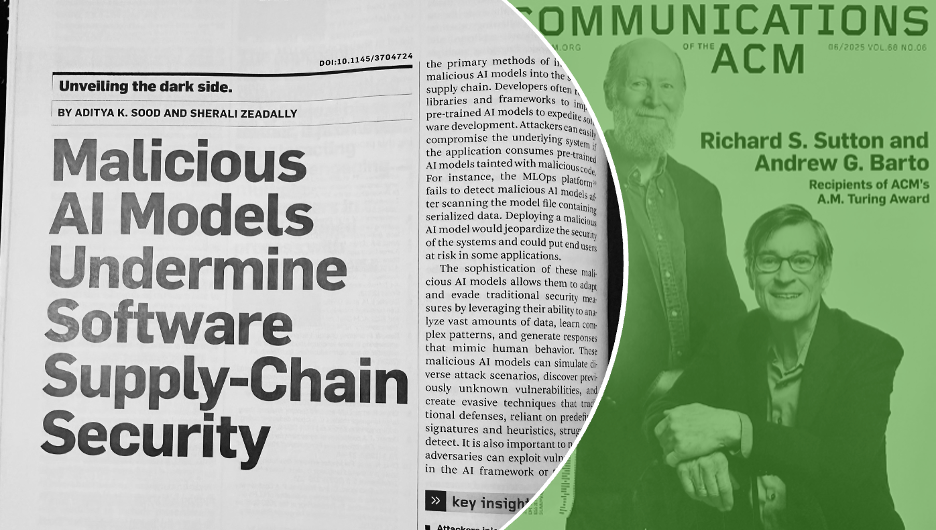
Our latest research on the challenges associated with malicious AI models has been published in the Communications of the ACM magazine, titled “Malicious AI Models Undermine Software Supply-Chain Security.” This research was conducted in collaboration with Dr. Sherali Zedally, a professor at the University of Kentucky.
The increasing integration of Artificial Intelligence (AI) models into software development and deployment pipelines introduces a novel and potent threat to software supply chain security. Unlike traditional malware embedded in code, malicious AI models can subtly alter behavior, influence decisions, or exfiltrate data from within systems where they are expected to perform legitimate functions. This unique capability allows attackers to compromise software at a deeper, more insidious level, leveraging the model’s inherent complexity and predictive power for nefarious purposes, often without triggering conventional security alarms.
The primary vectors for introducing these compromised AI models are through tainted development tools, maliciously modified libraries, or pre-trained models sourced from untrusted repositories. Once integrated, these models can act as Trojan horses, executing unauthorized code, exfiltrating sensitive data, manipulating data integrity, or enabling unauthorized access to
critical systems. The article highlights an attack flow model, breaking down how sophisticated payloads can move through the supply chain to achieve their malicious objectives, posing a significant challenge to an organization’s overall cybersecurity posture.
Detecting and mitigating such threats is particularly challenging due to the inherent opacity and complexity of AI models. Their “black box” nature often makes it difficult to ascertain whether a model is behaving maliciously or simply performing as designed, especially when the malicious payload is subtle or designed to activate under specific, rare conditions. Furthermore, traditional signature-based security defenses are ill-equipped to identify these novel, behavior-driven attacks, as they do not rely on static code signatures or easily identifiable patterns. This limitation necessitates a fundamental shift in how organizations approach software supply chain security to account for these intelligent and adaptive adversaries.
To address these growing risks, organizations must implement a multi-layered defense strategy. Key recommendations include rigorously vetting and sourcing AI models only from trusted repositories, employing cryptographic validation to ensure model integrity, and maintaining strict, controlled access to third-party AI assets. Additionally, utilizing secure model serialization formats and sandboxing AI models within isolated execution environments are crucial steps to contain potential threats. The overarching message emphasizes the critical need for continuous vigilance, proactive security measures, and a deep understanding of the unique characteristics of AI-driven attack payloads to foster effective threat detection, prevention, and mitigation in this evolving threat landscape.
The complete magazine is available here.

About the author