
The Ultimate Guide to Unified SASE in 2025

As businesses grapple with the accelerating pace of digital transformation, remote work, and increasingly sophisticated cyber threats, a new approach to networking and security has emerged as essential: Unified Secure Access Service Edge (SASE).
Originally conceptualized by Gartner in 2019, SASE (pronounced “sassy”) has matured significantly by 2025, with Unified SASE offering the most streamlined, scalable, and secure framework for organizations operating in today’s complex IT landscape.
What Is Unified SASE?
Unified SASE refers to a cloud-native architecture that converges network and security services into a single platform delivered primarily by one vendor. It’s designed to provide secure, optimized access to applications and resources from anywhere in the world.
In contrast to earlier SASE implementations—often cobbled together from multiple technologies—Unified SASE simplifies management, improves performance, and enhances security posture by eliminating integration complexity and policy inconsistencies.
Why Unified SASE Is Crucial in 2025
In 2025, businesses face mounting pressure to operate with greater efficiency amid a volatile global climate marked by economic uncertainty, trade conflicts, and supply chain disruptions. Organizations are under intense scrutiny to reduce operational costs while maintaining robust performance and security across increasingly distributed workforces and digital infrastructures.
This environment has intensified the demand for streamlined, cloud-delivered networking and security models—like Unified SASE—that consolidate tools, reduce vendor sprawl, and eliminate redundant infrastructure. By unifying access and protection under a single, agile platform, enterprises can adapt more quickly to change, optimize resource use, and remain resilient in the face of rising costs, technological developments, and global instability.
Trade wars and rising costs aside, other persisting challenges drive the need for Unified SASE:
-
- Explosion in hybrid and remote work:
Even post-pandemic, 60-to-64% of global enterprises now support hybrid work as a permanent fixture. This has broadened the threat landscape and increased reliance on cloud-delivered services.
-
- Application sprawl and multi-cloud complexity:
Enterprises now use hundreds of SaaS applications and multiple IaaS platforms (e.g., AWS, Azure, GCP), creating visibility and control gaps.
-
- Rise in AI-driven threats:
Cybercriminals have begun leveraging generative AI to automate phishing, exploit development, and evasion techniques.
-
- Regulatory expansion:
New data privacy laws in the EU, U.S., and APAC require continuous compliance, data sovereignty controls, and fine-grained user activity tracking.
-
- Performance expectations:
Users expect low-latency access regardless of location or device—making old, backhauled architectures obsolete, especially in the era of cloud computing and generative AI.
Piecing together a SASE architecture using multiple vendors opens the door for unnecessary complexities that may hinder the agility, visibility, and security of your enterprise operations. All these challenges and more necessitate a modern, unified, cloud-native security and networking model that is scalable and streamlined.
8 Core Components of a Unified SASE Architecture
Unified SASE is composed of tightly integrated networking and security capabilities. Here are the major building blocks:
1. Software-Defined WAN (SD-WAN)
SD-WAN is the networking backbone of SASE, enabling intelligent traffic routing over multiple links (MPLS, broadband, LTE, 5G). This provides application-aware routing, path selection, WAN optimization, and link resiliency.
The best Unified SASE providers offer their own private global network mesh, rather than relying on the public internet or hard-to-scale MPLS networks. By building an integrated private network backbone (like Aryaka’s Zero Trust WAN), these Unified SASE providers allow for true low-latency connection, end-to-end visibility over the network, and guaranteed bandwidth capabilities and traffic acceleration.
2. Cloud Access Security Broker (CASB)
A Cloud Access Security Broker is a security solution that sits between users and cloud service providers to enforce enterprise security policies. It provides visibility into cloud application usage, detects shadow IT/AI, and applies established policy controls to protect sensitive data across SaaS, PaaS, and IaaS platforms.
CASBs work hand-in-hand with key capabilities such as data loss prevention (DLP), threat protection, and compliance monitoring. By acting as a gatekeeper for cloud access, CASBs help organizations securely adopt cloud services without sacrificing control or compliance.
3. Secure Web Gateway (SWG)
A Secure Web Gateway is a security solution that protects users from web-based threats by monitoring and filtering internet traffic in real time. Positioned between users and the internet (and distributed along a network of PoPs), a SWG blocks access to malicious websites, prevents phishing attacks, enforces acceptable use policies, and inspects encrypted traffic for hidden threats.
Modern cloud-based SWGs provide consistent protection for users regardless of location or device, making them essential for securing today’s remote and hybrid work environments.
4. Zero Trust Network Access (ZTNA)
Zero Trust Network Access is a modern security framework that provides secure, identity-aware access to applications and services based on the principle of “never trust, always verify.”
Unlike traditional VPNs that grant broad network access, ZTNA enforces strict, context-based access controls, ensuring users and devices are continuously authenticated and authorized before connecting to specific resources. By minimizing exposure and reducing lateral movement, ZTNA significantly enhances security, especially in remote work environments and cloud-centric infrastructures.
5. Firewall as a Service (FWaaS)
Firewall as a Service (FWaaS) is a cloud-delivered solution that provides scalable, centralized firewall protection without the need for on-premises hardware. It offers advanced next-gen firewall capabilities like traffic inspection, URL filtering, policy enforcement, and threat prevention across all user locations.
Next-Generation Firewalls (NGFWs) enhance traditional firewalls by incorporating features such as deep packet inspection, intrusion prevention, application awareness, and user identity integration. When delivered as a service, NGFWs become part of a broader Unified SASE architecture, enabling consistent security enforcement across hybrid environments with greater agility and simplified management.
6. Data Loss Prevention (DLP)
Data Loss Prevention (DLP) is a security technology designed to detect and prevent the unauthorized sharing, transfer, or exposure of sensitive data. DLP works by monitoring data in motion (e.g., email, web traffic), at rest (e.g., stored files), and in use (e.g., active applications) to identify confidential information—such as financial records, personal identifiers, or intellectual property—based on predefined policies.
Once detected, DLP enforces controls like alerting, blocking, or encrypting data to ensure compliance with regulations and protect against insider threats or accidental leaks across endpoints, cloud services, and networks. What’s more, DLP policies are applied consistently across all channels and locations when integrated into a Unified SASE environment.
7. Unified Management and Policy Engine
The unified management and policy engine is the central control layer of a Unified SASE architecture, offering a single, cloud-based console for defining, enforcing, and monitoring both networking and security policies across the entire organization. It leverages rich contextual data—including user identity, geographic location, device posture, behavioral patterns, and dynamic risk scoring—to apply adaptive, fine-grained controls in real time.
The centralized policy management of Unified SASE eliminates the need to configure policies separately across disparate systems, ensuring consistent enforcement regardless of where users or applications reside. By enabling policies to be created once and applied universally, it reduces administrative overhead, minimizes the risk of misconfigurations, and enhances both agility and security posture.
8. Cloud-Native Global Fabric
A cloud-native global fabric is the foundation that enables Unified SASE to deliver consistent, high-performance networking and security at a global scale. Built on a distributed edge infrastructure composed of strategically located Points of Presence (PoPs), this fabric places users and applications as close as possible to enforcement and connectivity hubs. These PoPs act as intelligent relay points, allowing user traffic to be inspected, secured, and routed efficiently without backhauling data to centralized data centers.
In a true Unified SASE architecture, this global fabric is ideally constructed and managed by the provider, rather than strung together over a public internet SD-WAN or customer-managed MPLS network. By constructing their own global network mesh, Unified SASE providers can guarantee high-bandwidth, low-latency connections from anywhere in the world, unlike the “best effort” routing provided by public internet SD-WAN or traffic hairpinning under MPLS.
This architecture not only ensures low-latency access to cloud applications and services, but also enables localized enforcement of security policies, regardless of user location. As a result, organizations benefit from faster application performance, better gen AI workload performance, improved user experience, and more resilient, geographically aware protection against threats.
The Benefits of a Unified, Single-Vendor SASE Solution
By 2025, the market has shifted decisively in favor of converged, single-vendor Unified SASE solutions and with good reason:
1. Simplified Operations
Unified SASE simplifies day-to-day operations by providing a single pane of glass for policy management, troubleshooting, and reporting. This centralized interface consolidates previously siloed network and security tools, making it easier for IT and security teams to manage policies, monitor performance, and respond to issues. Deployment and administration are significantly streamlined, reducing the need for complex integrations or manual configuration across multiple platforms.
2. Consistent and Universal Security Posture
With Unified SASE, security policies are consistently applied to users and devices no matter where they connect from—whether it’s the office, home, or on the move. This continuity ensures that protection does not degrade with location or connection method. By eliminating the inconsistencies and gaps that often arise in fragmented, multi-vendor environments, a unified security architecture helps prevent policy drift and misconfigurations that could otherwise introduce risk.
3. Enhanced Visibility and Analytics
A Unified SASE platform delivers comprehensive, end-to-end visibility into users, devices, applications, and potential threats across the entire network. All traffic, regardless of source or destination, can be monitored and analyzed through centralized logging and telemetry. This unified insight, combined with risk-based analytics, allows organizations to detect anomalies faster, investigate incidents more thoroughly, and respond to threats with greater precision.
4. Lower Total Cost of Ownership (TCO)
By consolidating security and networking functions under a single vendor, Unified SASE reduces the need for multiple licensing agreements, complex integrations, and resource-intensive management efforts. The cloud-native delivery model further lowers capital expenditures by eliminating the need for costly on-premises appliances. Combined, these factors lead to a more predictable and reduced operational cost structure over time.
5. Optimized User Experience
Unified SASE enhances performance by leveraging a direct-to-cloud architecture that removes the bottlenecks of traditional VPN or backhauled traffic. Instead of routing data through a central data center, traffic is intelligently directed through the nearest SASE point of presence (PoP), reducing latency and improving application responsiveness. This results in a seamless, high-performance experience for users wherever they work.
6. Faster Innovation
Because Unified SASE is delivered by a single vendor, feature development, security updates, and enhancements can be rolled out faster and with better alignment. Vendors can innovate quickly without being constrained by compatibility issues or fragmented release cycles. A unified product roadmap ensures that updates are cohesive and that new capabilities are integrated seamlessly, keeping organizations on the cutting edge of performance and protection.
7. Future Proofing Your Networking and Security
Piggybacking off the ability to innovate faster, Unified SASE creates an agile, flexible, and scalable infrastructure ready to tackle evolving technologies and challenges. For example, the rapid growth of gen AI has simultaneously boosted productivity in many market sectors, while opening the door for shadow AI as threat and AI workload performance issues as a challenge.
Unified SASE is primed to tackle the issues of unmanaged and unmonitored AI adoption, while providing a scalable network infrastructure built to handle the increasing demands of those same AI capabilities. Even outside of AI, Unified SASE is the way forward for enterprises looking for networking and security that evolves as they do.
Pitfalls of Multi-Vendor SASE Implementations
Many organizations in the early 2020s attempted to construct SASE architectures by integrating separate SD-WAN, SWG, ZTNA, and CASB vendors. This approach is now seen as inefficient and ineffective due to:
1. Integration Complexity
Building a SASE architecture using multiple vendors introduces significant integration complexity. Each tool or service often requires separate configuration, maintenance, and custom API integrations to function together. This patchwork approach not only increases the time and resources needed to deploy and manage the environment but also introduces compatibility issues that can create operational friction and security gaps.
2. Policy Fragmentation
When security and networking components come from different vendors, each system typically has its own policy engine, syntax, and enforcement model. This leads to inconsistent policy definitions, making it difficult to maintain uniform access rules, compliance settings, or data protection strategies. The result is a fragmented security posture with greater potential for error or oversight.
3. Security Gaps
Multi-vendor setups often create visibility and enforcement blind spots. With disparate tools operating in silos, critical context—such as user identity, device status, or risk level—may not be shared across the system. These gaps can be exploited by attackers to bypass detection or move laterally within the network, weakening the overall security framework.
4. Operational Silos
Separate networking and security platforms can lead to divided responsibilities and misaligned priorities between IT and security teams. This lack of coordination can result in duplicated efforts, longer resolution times, and reduced overall efficiency. Unified SASE fosters cross-functional collaboration by consolidating operations under a shared framework and set of tools.
5. Increased Mean Time to Respond (MTTR)
When incidents occur in a multi-vendor environment, investigating and resolving them is often slower due to the need to manually correlate data from different sources. Analysts must piece together logs, alerts, and telemetry from separate consoles, which delays incident triage and containment. A unified platform accelerates detection and response by presenting correlated insights in one place.
Why Aryaka’s Unified SASE as a Service Is Built for 2025
In today’s rapidly evolving digital landscape, enterprises require more than just a collection of security and networking tools—they need a fully integrated platform that can meet the complex demands of global connectivity, cybersecurity, and real-time observability. Aryaka’s Unified SASE as a Service is purpose-built to address these needs in 2025 and beyond, delivering a cloud-native architecture that combines performance, protection, and operational simplicity.
Learn More About Unified SASE as a Service with Aryaka Enlighten
Unlike piecemeal solutions, Aryaka owns and develops the entire platform stack, including:
- Zero Trust WAN
- NGFW-SWG
- CASB
- IPS
- DLP (Coming Soon)
- Anti-Malware
With Aryaka Unified SASE as a Service, we ensure seamless integration, centralized policy enforcement, and accelerated innovation. Our globally distributed Zero Trust WAN offers low-latency access and regional redundancy, supporting high-performance connectivity for both cloud workloads and hybrid workforces.
Enhancing our security capabilities, Aryaka also empowers enterprises with rich observability through AI>Observe, enabling real-time monitoring, telemetry, and analytics across users, applications, and traffic flows.
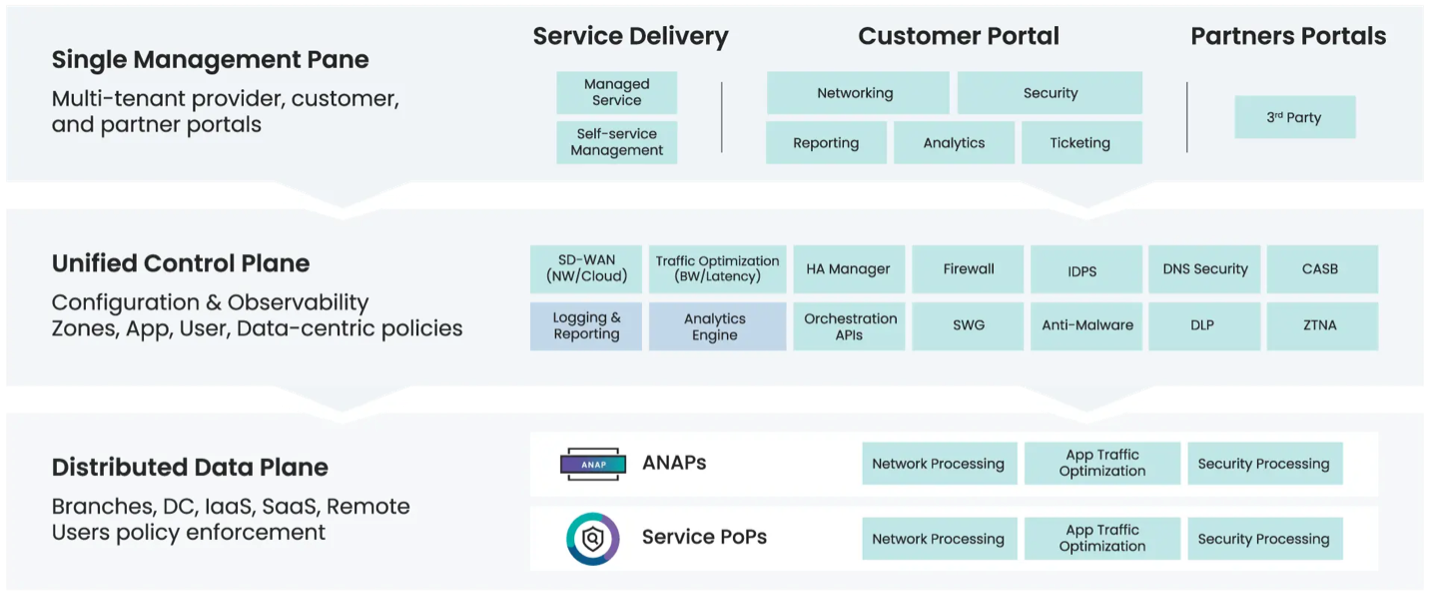
In a year marked by rising cyber threats, bandwidth-heavy AI workloads, and geopolitical uncertainty, Aryaka provides the convergence, control, and clarity enterprises need to operate securely and efficiently—wherever their users and data reside. On top of it all, we offer Unified SASE as a Service as a fully, partial-, or self-managed service, enabling enterprise to focus on what it does best, rather than chasing network scaling issues and security alerts.
Final Thoughts: The Future of Unified SASE
Unified SASE isn’t just a trend—it’s a foundational pillar for the modern enterprise in 2025 and beyond. As the edge dissolves and the digital perimeter expands, organizations can no longer rely on patchwork solutions or legacy architectures. Instead, they must embrace cloud-delivered, identity-centric, policy-unified platforms that offer visibility, agility, and security without compromise.
By investing in a Unified SASE platform now, businesses future-proof their networks, reduce risk, and empower workforces to connect and collaborate securely—anytime, anywhere.

About the author
