5 Security Threats Posed by Shadow AI (and How Unified SASE as a Service Can Help)

AI large language models (LLMs) are becoming a core component of enterprise operations. From automating workflows to driving customer insights, organizations are racing to leverage AI to gain competitive advantages. However, with the rise of AI tools comes a growing, often invisible risk: Shadow AI.
Much like Shadow IT—which refers to the use of unauthorized hardware or software in an organization—Shadow AI represents the unsanctioned or unmonitored use of AI applications by employees, departments, or third parties. While often well-intentioned, Shadow AI introduces serious security, compliance, and operational challenges that enterprises cannot afford to ignore.
Let’s explore five major security threats posed by Shadow AI—and how Unified SASE as a Service will help mitigate them effectively.
1. Improper Data Handling
AI tools rely on massive amounts of data to function efficiently. When employees use AI tools outside of IT’s purview, they often upload or feed proprietary, confidential, or sensitive data into public AI models without understanding the risks involved.
This opens the door to:
- Data exfiltration and loss
- Unintentional sharing of regulated or protected information
- Lack of auditability and control over how data is stored, used, or trained upon
For instance, an employee might input customer data or source code into a free generative AI tool without realizing that the information could be stored, reused, or leaked by the third-party provider.
2. Regulation and Compliance Violations
From GDPR and HIPAA to CCPA and industry-specific mandates, regulatory compliance is non-negotiable. Shadow AI directly undermines compliance efforts by introducing unknown data flows and interactions with external AI providers that do not meet regulatory standards.
If data subject to compliance regulations is uploaded to an unvetted AI tool, your organization could face:
- Fines and legal consequences
- Breach of contractual obligations
- Reputational damage
What’s worse: without visibility into what tools are being used, organizations may not even realize they’re out of compliance until it’s too late.
3. Lack of AI Application Visibility
One of the biggest challenges of Shadow AI is its invisibility. Employees and teams can access web-based AI tools or run open-source models locally with little to no oversight from IT. This results in a lack of visibility into:
- Who is using what AI tools
- What data is being shared or processed
- How that data is being used or stored
This blind spot makes it nearly impossible to enforce consistent security policies, assess risks, or detect anomalies. It also undermines efforts to standardize AI usage across the organization for safety and efficiency.
4. Disclosure of Sensitive Information
AI models, especially generative ones, can retain and inadvertently reproduce sensitive input data in future outputs. If internal information such as financial forecasts, product plans, or login credentials are entered into a public AI tool, they may become part of that tool’s training set or cached outputs.
The result? Future users—inside or outside your organization—may receive answers that contain fragments of previously submitted confidential data.
Even if the model itself doesn’t retain the data, poor privacy practices on the AI vendor’s side could lead to breaches or leaks. Without governance and proper vetting, employees using Shadow AI are gambling with enterprise security.
5. Prompt Leaks and Contextual Exposure
Generative AI tools work based on user prompts. However, prompts themselves can sometimes include proprietary information, like business logic, customer issues, or even code. If employees use AI to assist in writing emails, building software, or analyzing data, they may unintentionally leak:
- Intellectual property
- Client data
- Internal strategies
These “prompt leaks” are difficult to detect and even harder to trace once they’re out. And in AI platforms where history is saved or shared, that context may be accessible to others—sometimes even publicly.
Shadow AI Is Here – So What’s the Solution?
Shadow AI isn’t going away. In fact, the number of AI tools available is growing every day. Enterprises need a proactive strategy that gives them control and visibility without stifling innovation.
That’s where Unified SASE comes into play.
How Aryaka Unified SASE as a Service Mitigates Shadow AI Risks
Unified SASE brings together networking and security in a single, cloud-delivered platform. It ensures secure, consistent access to applications, users, and devices—no matter where they are. Here’s how it helps tackle the threats posed by Shadow AI:
1. Enforces Data Usage Policies on your Global Network
Unified SASE enables organizations to define and enforce granular security policies across all traffic over your global network. That means even if an employee tries to access an unapproved AI tool, the system can:
- Block data uploads
- Restrict access based on user, device, or application context
- Log and alert on any policy violations
This keeps sensitive data from flowing to unauthorized services—even unknowingly.
Read More: Securing the Cloud with Aryaka CASB
2. Ensures Compliance with Centralized Visibility and Control
With full integration of networking and security, Unified SASE provides a centralized view of all traffic, users, and applications. IT teams can monitor and report on AI tool usage across the enterprise, ensuring that all data flows are in line with regulatory and internal compliance standards.
Unified policy management simplifies auditing and ensures consistent enforcement across remote users, branches, and cloud environments.
Read More: Aryaka AI> Observe Datasheet
3. Delivers Application and User-Level Visibility
Unlike traditional point solutions, Unified SASE offers deep observability into user behavior and application usage. It identifies Shadow AI tools in real time, giving IT teams insight into:
- What tools are being accessed
- How much data is being transmitted
- Whether sensitive information is at risk
This visibility is the first step toward controlling AI risk without shutting down productivity.
Read More: The Importance of a Cloud Access Security Broker (CASB)
4. Prevents Sensitive Data Exposure with Zero Trust Controls
Unified SASE platforms often include Zero Trust Network Access (ZTNA), which ensures that no user or device is trusted by default. With continuous authentication and context-aware access controls, organizations can limit who can access what—and when.
That means employees can only interact with pre-approved, secure AI services and cannot upload data to risky or unknown platforms.
Read More: Reimagining Zero Trust in the Evolving Application Access with GenAI
5. Supports Safe AI Use Through Flexible Deployment Models
Unified SASE adapts to your organization’s needs—whether you prefer self-managed, co-managed, or fully managed services. That flexibility allows you to:
- Roll out policies at scale
- Quickly add protections for new AI tools
- Integrate with secure browser services or API gateways to create safe environments for AI use
The result? A secure, scalable way to enable innovation without compromising compliance or confidentiality.
Read More: The Convergence of Networking and Security in Unified SASE Architecture
Aryaka Unified SASE as a Service Means Observability and Control
Shadow AI is an emerging threat that enterprises can’t afford to ignore. The combination of rapid AI adoption, employee-driven experimentation, and a lack of visibility creates a perfect storm for data leaks, compliance issues, and security gaps.
Read More: How Aryaka Unified SASE Accelerates & Secures the Growing Adoption of Generative AI Workloads
But with the right strategy—grounded in visibility, control, and integrated security—you can embrace the benefits of AI while minimizing the risks. Through the fully managed global backbone and security controls present at our POPs and network access points, Aryaka gives you the visibility your enterprise needs to identify generative AI traffic, prevent unwanted or unmanaged access, and monitor for anomalies and threats to your business.
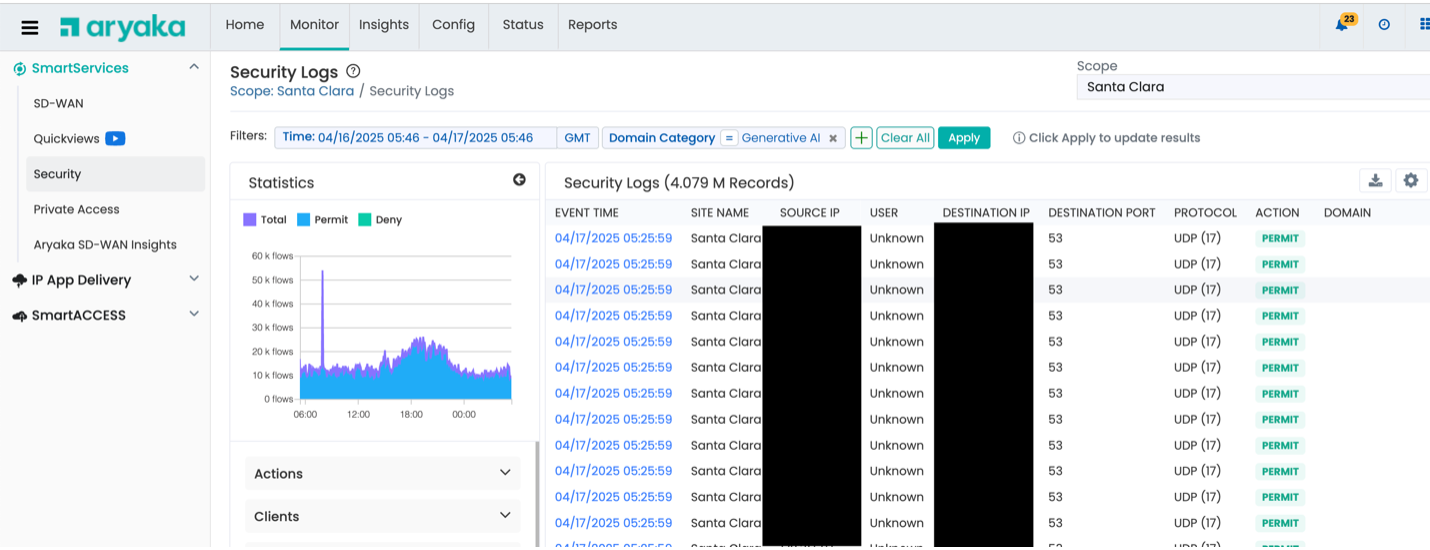
Insights into Generative AI logs on the Aryaka Platform
Source: Screenshot
Aryaka Unified SASE as a Service offers the modern foundation enterprises need to meet the challenges of Shadow AI head-on with our Zero Trust WAN, CASB, NGFW-SWG, and other security functions. By converging networking, security, and deep observability, Aryaka transforms a chaotic AI landscape into a managed, secure ecosystem for innovation.
Ready to get ahead of Shadow AI risks? Learn more about Aryaka’s Unified SASE as a Service and how it can protect your enterprise in the age of AI.

About the author
