
Taming Cybersecurity Sprawl: Unified SASE is Critical for Modern Enterprise

I’m not going to mince words. While cyber threats are continuing to rise at an astonishing rate without any signs of slowing, the cybersecurity industry isn’t making things much easier to combat this problem. In many ways, they are making things arguably worse.
Enterprises face an unprecedented threat landscape, growing regulatory demands, and a workforce that expects secure access from anywhere at any time. To keep up, many organizations have adopted a patchwork of point solutions, spurred on by a flurry of fact and marketing fiction. Companies’ security toolsets are looking like a harlequin clown car: one tool for malware protection, another for network firewalling, another for intrusion prevention, another for remote access, and yet another for cloud access security.
Everyone has a notification for this and a dashboard for that, but where is the streamlined focus?
While these tools solve individual problems, together they create a growing crisis: cybersecurity sprawl.
What is Cybersecurity Sprawl?
Cybersecurity sprawl refers to the unchecked proliferation of disconnected security tools, platforms, and vendors within an enterprise. As organizations rapidly digitize operations and extend their networks to the cloud and hybrid work environments, their security infrastructures often grow reactively. Instead of a unified strategy, they end up with dozens of loosely integrated products, each with its own console, policy engine, telemetry, and licensing model.
This sprawl is not just a management nuisance—it creates real, tangible risks to the business.
The Rise of Cybersecurity Sprawl
Several factors are fueling the rise of cybersecurity sprawl:
- Cloud and SaaS Adoption: As enterprises adopt multi-cloud strategies and rely on SaaS for critical business functions, new security gaps emerge at the application and access layer.
- Remote and Hybrid Work: The shift to anywhere work has increased the attack surface and introduced a need for more endpoint, identity, and access control solutions.
- Shadow IT and Shadow AI: Employees using unauthorized apps and AI tools to boost productivity introduce visibility blind spots and regulatory risks.
- Compliance and Governance Requirements: Complex and evolving mandates like GDPR, HIPAA, and PCI DSS demand granular controls and reporting that often require niche solutions.
- Vendor Fragmentation: The cybersecurity market is saturated with vendors promising to solve individual pain points, often leading to short-term adoption without long-term strategy.
Converging Networking and Security: Full Visibility, Centralized Control
A key driver behind cybersecurity sprawl is the traditional separation between networking and security infrastructures. Enterprises often rely on an assortment of SD-WAN vendors, firewall appliances, remote access tools, and cloud security platforms—each operating in its own silo. This fragmentation leads to inconsistent policy enforcement, overlapping alerts, and limited visibility across the enterprise.
FOR ADDITIONAL CONTEXT: Surprising Cybersecurity Sprawl Facts
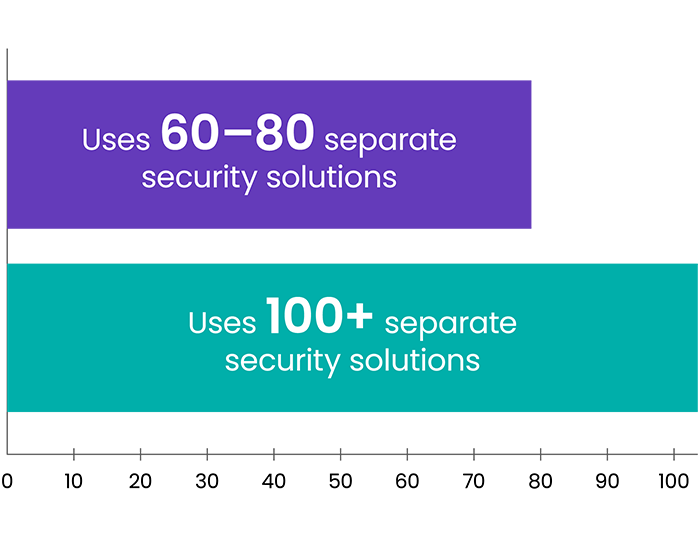
Large organizations now use an average of 60–80 separate security solutions, with some managing over one hundred tools.
(Source: CDO Trends)

Out of 950 security professionals surveyed, 68% managed between 10–49 tools, and 40% described tool integration as “very” or “somewhat” difficult.
(Source: Security Boulevard)

A 2021 survey found that 71% of enterprises were underutilizing their security tools, with only 22% of them playing a vital role in threat detection and response.
(Source: Business Wire)
In a world where cyber-attacks are a persistent and costly threat, it’s chilling to hear sentiments that highlight underutilization of security tools, difficult integration, and a growth in tools not correlating with better protection. Clearly there is a disconnect between the cybersecurity solutions currently in use and the users looking for an effective shield.
The Cost of Sprawl: Security, Complexity, and Budgetary Burden
While it may seem safer to have “more” security tools, the reality is quite the opposite. Well, not exactly. “More” tools aren’t the problem. The problem is more tools from MULTIPLE vendors with patchwork integrations, inconsistency in policy formation and enforcement, as well as ballooning costs. These issues create more problems, including:
1. Security Gaps and Inconsistent Policy Enforcement
Different tools mean different policy engines, different rule sets, and different interpretations of risk. This fragmentation results in inconsistent enforcement, leaving critical gaps that attackers can exploit.
2. Operational Complexity and Alert Fatigue
Managing dozens of security consoles, each generating logs and alerts, overwhelms IT and security teams. The more tools in play, the harder it becomes to distinguish signal from noise, increasing the chance of missing a real threat.
3. High Total Cost of Ownership (TCO)
With each new security product comes additional costs: licensing, training, maintenance, and headcount to manage it all. This multiplies operational expenses and locks budget in tools that may offer diminishing returns.
4. Delayed Incident Response
When incidents occur, siloed systems delay root cause analysis and remediation. Integrating logs across systems is slow, manual, and error-prone.
5. Lack of End-to-End Visibility
No single pane of glass means security leaders lack context. Without a unified view, it’s difficult to detect lateral movement, data exfiltration, or policy violations across the entire environment.
Why Unified SASE is the Answer
When networking and security are converged into a unified architecture, these issues are significantly reduced. With a shared policy engine and seamlessly integrated orchestration, security teams can apply and monitor controls from a single console. Policy changes take effect globally and instantly, whether for data centers, cloud applications, or remote users. No more mismanagement and misconfiguration.
This level of integration streamlines operations and improves organizational agility. Visibility becomes end-to-end, helping teams trace issues from user to application with minimal friction. It also reduces the risk of blind spots and misconfigurations that stem from multiple, uncoordinated systems. In today’s fast-paced threat landscape, convergence offers a path to more resilient and manageable cybersecurity.
To counter the sprawl, modern enterprises need an architectural shift—one that converges security and networking into a unified platform. This is the promise of Unified Secure Access Service Edge (SASE), and specifically, Unified SASE as a Service delivered by Aryaka.
Aryaka Unified SASE as a Service: Designed to Solve Cybersecurity Sprawl
Aryaka’s Unified SASE as a Service provides a single platform that converges SD-WAN, advanced security, and observability. This convergence addresses sprawl head-on in two fundamental ways:
1. Converged Infrastructure = Full Visibility and Control
Rather than stitching together disparate products, Aryaka delivers networking and security in one natively integrated platform, or as we call it, “OnePASS Architecture.”
This convergence eliminates security blind spots and ensures consistent enforcement of access, identity, and threat protection across the entire enterprise—from branch to cloud to remote users.
2. Simplified Security with Deep Integration
Aryaka’s Unified SASE brings together a powerful suite of security capabilities:
- Next-Gen Firewall + Secure Web Gateway (NGFW-SWG): Delivers deep packet inspection, URL filtering, and access controls to prevent unauthorized traffic and malware infections.
- Cloud Access Security Broker (CASB): Provides visibility into and control over SaaS and cloud usage, eliminating risks from Shadow IT.
- Intrusion Prevention System (IPS): Detects and blocks known and unknown threats in-line, ensuring threat prevention at the point of access.
- Anti-Malware: Scans and neutralizes malicious content in real time before it enters the network.
- Secure Remote Access: Enables Zero Trust access for remote and hybrid users with policy-driven access controls.
- AI>Observe: Provides AI-powered observability and threat detection using advanced analytics and security telemetry to improve detection and response.
All of this and more is delivered as a self, partial, or fully managed service, all backed by Aryaka’s global private network for performance and reliability.
Real-World Benefits of Aryaka’s Unified Approach
By consolidating cybersecurity under a unified framework, enterprises gain:
- Improved Efficiency: Fewer tools mean less management overhead, faster troubleshooting, and more streamlined operations.
- Better Security Outcomes: With centralized policy and visibility, threats are detected and mitigated faster, with fewer gaps.
- Lower TCO: Reduction in licensing, infrastructure, and headcount requirements leads to significant OpEx savings.
- Scalability: New users, applications, and locations can be onboarded quickly without complex integrations.
- Enhanced User Experience: Optimized routing, latency reduction, and consistent policy enforcement create a seamless experience for users.
READ MORE: Aryaka Customer Results: Mapping Real-World Impact to Strategic Use Cases
The Path Forward
Enterprises that continue to layer on point products in response to evolving threats are not just burning budget—they’re increasing risk. Cybersecurity sprawl is unsustainable. What organizations need is not more products, but a better platform.
Aryaka Unified SASE as a Service delivers just that: a modern, simplified, and effective approach to securing today’s distributed enterprise.
Ready to collapse complexity and reclaim control?
Schedule a demo of Aryaka Unified SASE as a Service today and see how a unified platform can reduce sprawl while boosting security, performance, and agility.

About the author
