How WAN Optimization Accelerates Cloud, SaaS, and AI Workloads.

Enterprises today are undergoing massive digital transformation. Cloud-first strategies have become the norm, and workloads are increasingly distributed across public cloud infrastructure (IaaS), SaaS platforms, and generative AI environments. However, as businesses continue to expand their use of these services, they are running into performance roadblocks that legacy connectivity models simply weren’t built to handle.
Many enterprises are still relying on legacy MPLS or public internet-based SD-WAN to connect users to cloud applications and infrastructure. These networks, while serviceable in the past, are increasingly ill-equipped to handle the scale, complexity, and performance demands of modern workloads, especially generative AI models that require high throughput and low latency.
Let’s explore the specific challenges enterprises face with IaaS, SaaS, and AI workloads—and how WAN optimization over a managed SD-WAN mesh offers a purpose-built solution for SaaS acceleration, improved application performance, and TCP acceleration.
The Shortfalls of MPLS and Public SD-WAN in the Cloud Era
Legacy connectivity models are failing for one core reason: they weren’t designed for distributed, cloud-centric, or AI-driven environments. Here are the major issues:
1. MPLS Limitations
- High costs and inflexibility: MPLS circuits are expensive, rigid, and slow to deploy, making them a poor fit for dynamic cloud environments.
- Datacenter backhaul: With MPLS, cloud traffic is often routed back through a central data center, adding latency and degrading application performance.
- Lack of cloud-native support: MPLS doesn’t natively connect to SaaS or IaaS platforms, requiring complex workarounds.
2. Public Internet-Based SD-WAN Limitations
- Unpredictable latency and jitter: The public internet offers no SLA, leading to performance degradation for latency-sensitive workloads like video, VoIP, or AI inference.
- Inconsistent throughput: Packet loss and congestion impact data transfer speed and reliability.
- Security and observability gaps: DIY SD-WAN deployments often lack integrated threat protection and visibility across cloud and edge traffic.
Workload-Specific Challenges: IaaS, SaaS, and AI
Getting down to the specifics, there are certain challenges facing enterprises looking to operate in the cloud and in the world of AI. In this case, these challenges are created by legacy network architectures that weren’t built to serve the needs of modern cloud computing, such as:
1. IaaS (Infrastructure as a Service)
Enterprises using platforms like AWS, Azure, and Google Cloud for hosting applications or storage face a major issue: ensuring high-performance and secure connectivity between on-prem sites, users, and cloud instances. Transferring large datasets between data lakes or connecting to VMs across regions over the public internet introduces unacceptable latency and packet loss, affecting both application performance and user productivity.
2. SaaS (Software as a Service)
Mission-critical apps like Microsoft 365, Salesforce, and ServiceNow demand fast, reliable access regardless of where the user is located. However, public SD-WAN lacks deterministic performance, leading to slow load times, dropped connections, and poor user experience—especially for remote or mobile users. SaaS acceleration becomes critical to maintain productivity and service levels.
3. Generative AI Workloads
AI model training and inference introduce entirely new demands. Training large models across distributed GPU infrastructure requires massive data movement with high throughput and deterministic latency. Inference, especially at the edge, requires real-time response and strict policy enforcement. Neither MPLS nor public SD-WAN is optimized for these use cases.
How a managed SD-WAN with WAN Optimization solve these Challenges
To overcome these hurdles, enterprises are turning to modern, managed SD-WAN architectures combined with advanced WAN optimization. Let’s break down how this combination addresses the core limitations of MPLS and internet-based SD-WAN.
1. Performance and Latency Optimization
A managed SD-WAN mesh provides a dedicated, SLA-backed backbone between global locations and cloud on-ramps. WAN optimization adds:
- Latency optimization to speed up long-distance connections.
- Application acceleration to prioritize business-critical traffic and improve overall application performance.
- Parallelization for faster data transmission between AI nodes or IaaS storage endpoints.
- TCP acceleration to enhance protocol efficiency, reducing retransmissions and boosting throughput for AI and SaaS apps.
2. Bandwidth Efficiency
A managed SD-WAN mesh ensures dedicated bandwidth without traffic bottlenecks and primetime throttling. In addition to this exclusivity, a managed SD-WAN also utilizes:
- Data compression to reduce the amount of traffic traversing the network.
- Data deduplication to eliminate repetitive transmissions. Enterprises reduce the burden on bandwidth, improving overall throughput and lowering costs.
3. Reliability and Application Experience
- Protocol optimization to streamline TCP/UDP behavior across the WAN.
- Load balancing across multiple paths for uninterrupted access.
- Packet order correction and error recovery for more stable cloud and SaaS application performance.
4. Security and Observability
Private SD-WANs can integrate security natively, but WAN optimization amplifies:
- Granular visibility into application performance
- Enhanced threat detection and prevention capabilities
Combined, these enhancements lead to a vastly improved experience for cloud, SaaS, and AI workloads—with measurable gains in user satisfaction, productivity, and operational efficiency.
Aryaka Zero Trust WAN: Purpose-Built for IaaS, SaaS, and AI
Aryaka Unified SASE as a Service includes the industry’s most robust managed global private network mesh, designed from the ground up to support next-gen cloud and AI workloads. Our WAN optimization engine is a cornerstone of this architecture.
LEARN MORE: Aryaka WAN Optimization Solution Brief
SaaS and Multi-Cloud Acceleration
Aryaka offers direct, optimized connectivity to leading SaaS providers, as well as application-aware routing to prioritize AI, video, and collaboration apps.
After the adoption of Aryaka’s Zero Trust WAN optimization, customers experience:
- Significant reduction in app load times
- Consistent user experience across geographies
- Reduced jitter and packet loss
With Aryaka, users access their cloud resources without interruptions, latency, or additional complexity.
LEARN MORE: Aryaka Multi-Cloud Acceleration Solution Brief
Aryaka AI>Perform: Acceleration Engine for AI Workloads
Aryaka AI>Perform is built to optimize traffic between enterprise sites and cloud platforms, including GPU-as-a-Service (GPUaaS) providers.
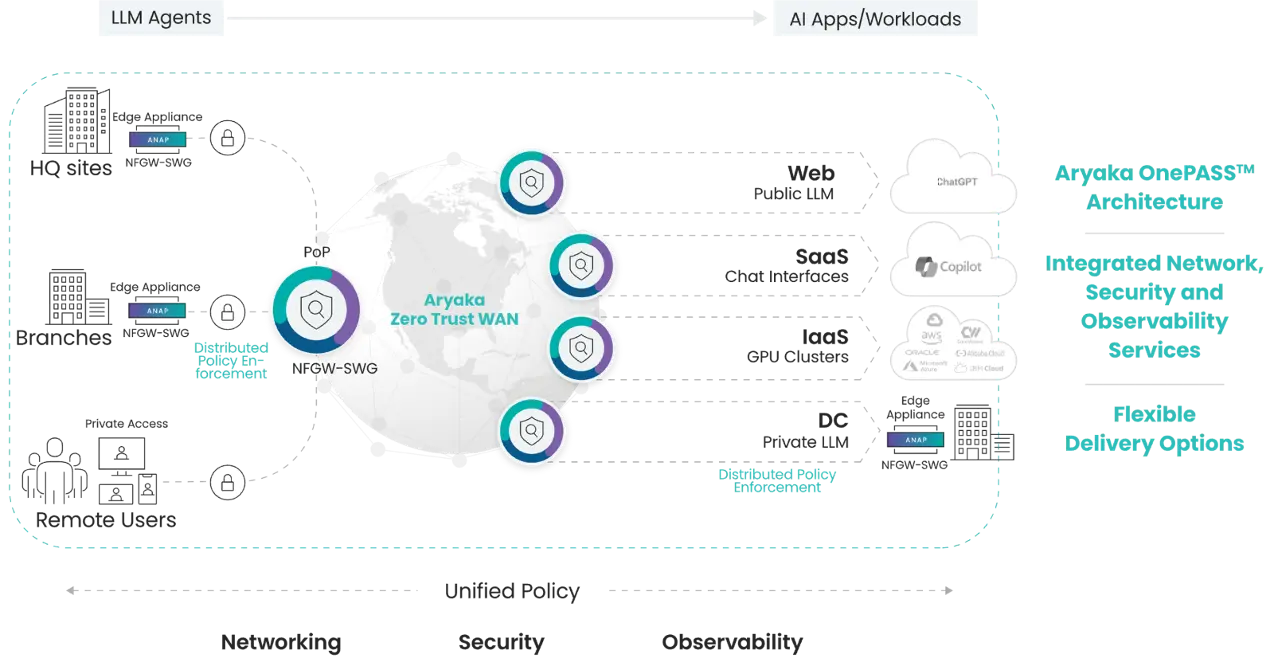
Key capabilities of Aryaka AI>Perform include:
- Deterministic latency across Aryaka’s global private network mesh
- WAN optimization that compresses and accelerates traffic to reduce training and inference time
- TCP acceleration to improve AI data flow across distributed compute and storage environments
- Improved GenAI performance at scale
Integrated Observability and Policy Enforcement
Aryaka’s WAN-optimized network includes integrated telemetry and security:
- AI>Observe provides full-stack visibility into traffic and performance bottlenecks.
- Shadow AI discovery powered by Aryaka CASB helps identify unsanctioned GenAI usage across SaaS tools and browsers.
- AI>Secure (coming H2 2025) will offer AI-specific threat prevention, including protection against model theft and unauthorized inference.

Closing Thoughts: Why It Matters
Enterprise workloads are no longer confined to data centers. They live across SaaS, IaaS, edge devices, and generative AI pipelines. The traditional WAN isn’t just a bottleneck—it’s a liability.
To keep pace with modern application demands, enterprises need a WAN that is optimized, secure, cloud-native, and AI-ready. Aryaka’s Zero Trust WAN, available through our Unified SASE as a Service platform, delivers all of this by combining a global private SD-WAN mesh with advanced WAN optimization and integrated security.
Whether you’re accelerating SaaS access for your distributed workforce, moving petabytes of data between AI workloads, or connecting remote users to cloud infrastructure, Aryaka ensures your network can keep up—without compromise.
Ready to experience AI-ready WAN performance? Visit www.aryaka.com to schedule your own personalized demo and begin your path on the Secure Networking Journey.

About the author
